Sanskrit Varnamala - संस्कृत वर्णमाला | How Sound Becomes Language
The Sanskrit Varnamala is the ordered inventory of every sound the language uses, 13 vowels, 33 consonants, and 2 dependent sounds. It is not an alphabet in the English sense. English inherited its letter order from Phoenician traders.
Sanskrit built its order from human anatomy, moving sound by sound from the throat to the lips. It is the most obvious what naturally a human could ever do to communicate in the first place. Therefore, Sanskrit is the most scientific language in the world.
Every mantra you chant is assembled from these forty-eight sounds. Learn them properly, and the Gayatri, the Ganapati Atharvashirsha, and the Bhagavad Gita stop being just text. They become living Devta.
Prerequisite: None. Start here. Next → Chapter – 2: Shabd Roop in Sanskrit
Course Index: Free Sanskrit Course Hub – Saralikrita Sanskritam
What is a Varna? Alphabets of Sanskrit
A Varna – वर्ण (varṇa) is an indivisible speech sound.
Sanskrit language flows downward, not upward. A वाक्य (vakya, sentence) breaks into पद (pada, words). Each पद breaks into वर्ण. In Sanskrit, the वर्ण itself is the cosmic energy, a sound that creates a cocoon of divinity when spoken in a certain manner.
Therefore, a वर्ण is a sound, not a shape on paper. Devanagari is simply the script that happens to record it faithfully. The same वर्ण written in Tamil, Bengali, or IAST remains the same वर्ण. Consequently, Sanskrit survived for millennia through recitation, long before anyone wrote it down.
The full collection carries a beautiful name: वर्णमाला (Sanskrit Varnamala) – literally, a garland of sounds. Furthermore, that garland splits cleanly into two families:
| Family | Devanagari | IAST | हिंदी अर्थ | English Meaning |
|---|---|---|---|---|
Vowels |
स्वरः |
svaraḥ |
स्वयं उच्चरित ध्वनि |
Sounds that speak on their own |
Consonants |
व्यञ्जनम् |
vyañjanam |
स्वर-आश्रित ध्वनि |
Sounds that need a vowel to be voiced |
A स्वर sounds complete by itself. A व्यञ्जन cannot. Try pronouncing क् alone; you will find the mouth stops, but no sound escapes. अ, + क् becomes क.
Sanskrit Varnamala - Vowels | Swara - स्वर:
The nine foundational vowel sounds in Sanskrit:
अ इ उ ऋ ऌ ए ऐ ओ औ
These nine are the seeds in the Sanskrit language.
ह्रस्व and दीर्घ – length system: Sanskrit measures vowels in मात्रा (mātrā), units of duration. This is where most learners lose accuracy, and where mantra practice suffers most.
ह्रस्व (hrasva) – Hindi: लघु स्वर – English: short, one मात्रा – अ इ उ ऋ ऌ
दीर्घ (dīrgha) – Hindi: दीर्घ स्वर – English: long, two मात्रा – आ ई ऊ ॠ ए ऐ ओ औ
Notice something important; ए ऐ ओ औ appear only in the दीर्घ column. They have no short counterpart, because each is a compound sound formed from two articulation points. Therefore they are always held for two मात्रा.
सवर्ण – Sibling sounds
Two vowels sharing the same articulation point, differing only in length, are called सवर्ण (savarṇa) – Hindi: समान उच्चारण स्थान वाले – English: homogeneous.
अ ↔ आ, इ ↔ ई, उ ↔ ऊ, ऋ ↔ ॠ
The word सवर्ण literally means similar. These becomes the entire engine of सन्धि (sandhi) in later chapters. When two सवर्ण vowels meet across a word boundary, they fuse into their long form. That single rule explains hundreds of mantra spellings you have wondered about.
| वर्ण | IAST | प्रकार | उच्चारण स्थान | English Note |
|---|---|---|---|---|
| अ | a | ह्रस्व | कण्ठ | Short, as in about |
| आ | ā | दीर्घ | कण्ठ | Long open vowel |
| इ | i | ह्रस्व | तालु | Short, as in bit |
| ई | ī | दीर्घ | तालु | Long, as in feet |
| उ | u | ह्रस्व | ओष्ठ | Short, as in put |
| ऊ | ū | दीर्घ | ओष्ठ | Long, as in pool |
| ऋ | ṛ | ह्रस्व | मूर्धा | Vocalic r – a vowel, not “ri” |
| ॠ | ṝ | दीर्घ | मूर्धा | Long vocalic r, rare |
| ऌ | ḷ | ह्रस्व | दन्त | Vocalic l, very rare |
| ए | e | दीर्घ | कण्ठ + तालु | Compound sound |
| ऐ | ai | दीर्घ | कण्ठ + तालु | Compound sound |
| ओ | o | दीर्घ | कण्ठ + ओष्ठ | Compound sound |
| औ | au | दीर्घ | कण्ठ + ओष्ठ | Compound sound |
Thirteen vowels in the standard count. A few traditions also list ॡ, the long form of ऌ, which brings the total to fourteen. It occurs almost nowhere in actual literature.
Sanskrit Varnamala - Consonants | Vyanjana - व्यञ्जनम्
There are 33 consonants in Sanskrit, mainly of 2 types:
1. Varga: 25 वर्ग – These 25 consonants organize into five Varga or class. Each वर्ग shares one articulation point.
| वर्ग | अघोष अल्पप्राण | अघोष महाप्राण | घोष अल्पप्राण | घोष महाप्राण | अनुनासिक |
|---|---|---|---|---|---|
| कवर्ग | क् | ख् | ग् | घ् | ङ् |
| चवर्ग | च् | छ् | ज् | झ् | ञ् |
| टवर्ग | ट् | ठ् | ड् | ढ् | ण् |
| तवर्ग | त् | थ् | द् | ध् | न् |
| पवर्ग | प् | फ् | ब् | भ् | म् |
Read that table downward and you travel through the mouth, from throat to lips. Read it across and you change only how the breath behaves. This is the absolute beauty of Sanskrit.
Two technical terms make the columns readable:
- अघोष (aghoṣa) – voiceless, the vocal cords stay still
- घोष (ghoṣa) – voiced, the vocal cords vibrate
- अल्पप्राण (alpaprāṇa) – little breath, unaspirated
- महाप्राण (mahāprāṇa) – great breath, aspirated
Place a hand on your throat and say क्, then ग्. The vibration you feel on the second is घोष. Now hold a palm before your mouth and say क्, then ख्. The puff of air on the second is महाप्राण.
2. Second type: य् र् ल् व् श् ष् स् ह्
These eight sit outside the Varga grid because they behave differently.
- अन्तःस्थ (antaḥstha) – Hindi: अर्धस्वर – English: semivowels – य् र् ल् व्
- ऊष्म (ūṣma) – Hindi: संघर्षी ध्वनि – English: sibilants and the aspirate – श् ष् स् ह्
The अन्तःस्थ sit “in between,” halfway between vowel and consonant. Indeed, य् is इ narrowed, र् relates to ऋ, ल् to ऌ, and व् to उ. This becomes a grammatical rule in Sandhi.
Therefore, 25 + 8 = 33 consonants.
Anusvara & Visarga in Sanskrit
Two further sounds enter the Sanskrit Varnamala:
- अनुस्वार (anusvāra), written ं , IAST ṃ – Hindi: नासिक्य ध्वनि – English: a pure nasal resonance following a vowel
- विसर्ग (visarga), written ः , IAST ḥ – Hindi: निःश्वास ध्वनि – English: a soft breath-release echoing the preceding vowel
Both are called स्वराश्रित (svarāśrita) – Hindi: स्वर पर आश्रित – English: vowel-dependent. They cannot exist alone. They cannot begin a word. They only ever attach to a vowel that came before them.
Look at नमः (namaḥ). The विसर्ग there is not a silent full stop. It is an audible outward breath, tinted by the अ before it – closer to nama-ha than to namah. Similarly, the ं in गं carries genuine nasal resonance, not a hard म् closure, it is a ग closure.
Therefore, 13 vowels + 33 consonants + 2 स्वराश्रित = 48 वर्ण is the complete Sanskrit Varnamala.
Anatomical design of Sanskrit Varnamala - उच्चारण स्थान
The 5 places of articulation in Sanskrit Language
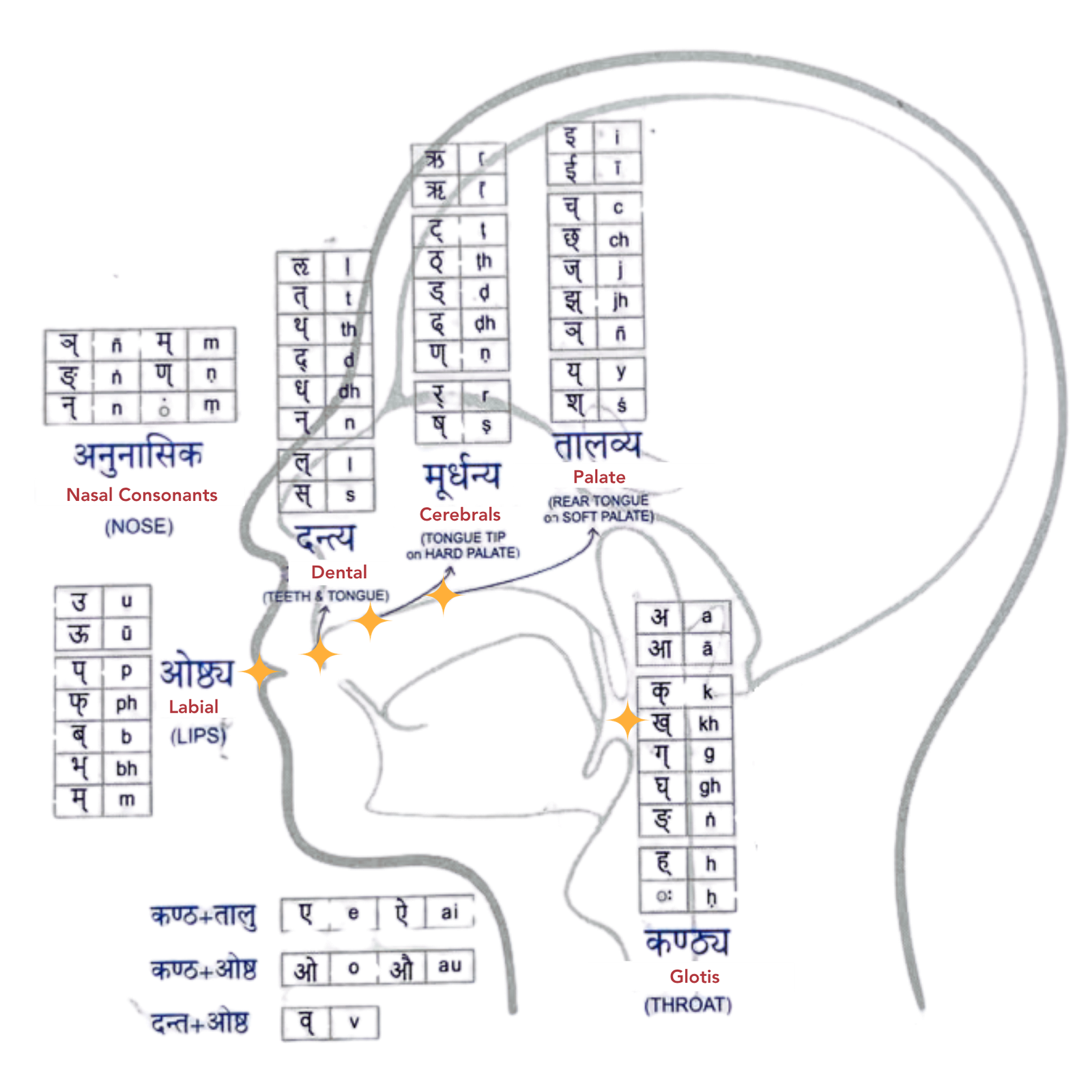
Here lies the design principle that makes the Sanskrit Varnamala unlike any alphabet on earth – it is anatomical.
| क्रम | स्थान | IAST | English (standard) | स्वर | व्यञ्जन |
|---|---|---|---|---|---|
| 1 | कण्ठ | kaṇṭha | Throat / velar | अ, आ | क् ख् ग् घ् ङ्, ह्, ः |
| 2 | तालु | tālu | Palate / palatal | इ, ई | च् छ् ज् झ् ञ्, य्, श् |
| 3 | मूर्धा | mūrdhā | Palatal ridge / retroflex | ऋ, ॠ | ट् ठ् ड् ढ् ण्, र्, ष् |
| 4 | दन्त | danta | Teeth / dental | ऌ | त् थ् द् ध् न्, ल्, स् |
| 5 | ओष्ठ | oṣṭha | Lips / labial | उ, ऊ | प् फ् ब् भ् म् |
| 6 | कण्ठतालु | kaṇṭhatālu | Throat + palate | ए, ऐ | |
| 7 | कण्ठोष्ठ | kaṇṭhoṣṭha | Throat + lips | ओ, औ | |
| 8 | दन्तोष्ठ | dantoṣṭha | Teeth + lips | व् | |
| 9 | नासिका | nāsikā | Nose | अनुस्वार | ङ् ञ् ण् न् म् (secondary) |
Trace positions 1 through 5 with your tongue. You will move steadily from the deepest point of the throat or glottis outward to the lips. The Sanskrit Varnamala is sorted along the vocal tract like measurements along a ruler.
Positions 6, 7, and 8 explain the compound sounds. ए is not an arbitrary vowel. It is the throat and palate acting together, which is precisely why अ + इ becomes ए in Sandhi. Therefore, the Sanskrit grammar derives from the from the biology of the body itself.
Why Sanskrit is called the most scientific language
The claim gets repeated everywhere, and here’s the precise evidence:
Most alphabets record whichever sounds a community happened to inherit. The Sanskrit Varnamala records what the human vocal tract can physically produce, then orders it by where production occurs. Therefore the sequence is not cultural. It is biological, and it would emerge identically in any human mouth on earth.
Now notice what the table you just read actually proves. अ is produced at कण्ठ, the deepest point the voice reaches. उ is produced at ओष्ठ, the outermost point before sound leaves the body. Every remaining वर्ण is articulated somewhere between those two boundaries.
Then म् closes the lips, and the passage seals.
That span already carries a name you know → अ + उ + म् = ॐ
| Component | वर्ण | उच्चारण स्थान | What the body does |
|---|---|---|---|
| A | अ | कण्ठ | The vocal tract opens at its deepest point |
| U | उ | ओष्ठ | Sound rolls forward to the outer limit |
| M | म् | ओष्ठ | The lips close and the passage seals |
| Resonance | अनुस्वार | नासिका | What remains lifts into the nasal cavity |
ॐ is therefore not one sound among many. It is the entire Varnamala of Sanskrit, the Vedic sound that rains divinity. Compressed into a single syllable – the opening of the vocal tract, its furthest reach, and its closure.
The Māṇḍūkya Upaniṣad treats these three mātrās as the totality of what can be uttered. The articulation table shows why that is literally true, and not merely symbolic.
Consequently, when tradition says every mantra arises from ॐ, it makes a phonetic statement before a metaphysical one. Sanskrit’s authority rests here. The language was mapped to the body that speaks it, and no other alphabet was built that way.
Additionally, the ॐ is the source of very existence of Universe, beyond, and multiple realms. It is the string vibration of Para-Brahma. These vibration exists and form the base of your body in the form of 7 energy-chakras.
Moreover, from the Sanskrit Varnamala to musical Swaras, from wavelengths of light, radiation, other frequencies to atomic vibrations, everything arises from Om.
This is intriguing as well as a fact known by Vedic scholars and Veda-pathi Brahmins.
Mantra Application: How scripture builds a Bija from the Varnamala
Now watch the theory construct an actual mantra.
The Ganapati Atharvashirsha confirms the structure of ॐ in its own words: अकारः प्रथमरूपम्। उकारो मध्यमरूपम्। मकारोऽन्त्यरूपम्। बिन्दुरुत्तररूपम्। – the अ is the first form, the उ the middle, the म् the final, the dot in the north is the brahman.
The गणपति bīja is then built by the same method. The Atharvashirsha instructs: गणादिं पूर्वमुच्चार्य वर्णादिं तदनन्तरम्। अनुस्वारः परतरः। – take the first sound of “गण,” add the first वर्ण, then place अनुस्वार after it.
Decoded: ग् (first sound of गण) + अ (the first वर्ण of the वर्णमाला) + ं (अनुस्वार) = गं
The scripture assumes you know the Sanskrit Varnamala. Without this chapter, that instruction is unreadable. With it, the bīja assembles itself in front of you.
Explore this further in our complete study of the Ganapati Atharvashirsha, where the varna-construction verses are examined line by line.
The same logic governs every graha bīja used in Jyotish remedies – रां, चं, बुं, and the rest. Each is a consonant plus a vowel plus अनुस्वार. Once you read the वर्णमाला, you stop memorising bījas and start understanding them.
Common mistakes learners make in reading Sanskrit
1. Reading ऋ as “ri.” ऋ is a vowel, produced at मूर्धा. It is not क् + र् + इ. Hindi speakers absorb this error early because Hindi pronounces ऋषि as rishi. In Sanskrit recitation, aim for a short, retroflex vowel closer to the r in American “bird.”
2. Flattening मात्रा in japa. Chanting a दीर्घ vowel short halves the sound. शान्ति with a short first vowel is a different word from शान्ति. Length is meaning, not decoration.
3. Treating अनुस्वार as म्. अनुस्वार is nasal resonance, not lip closure. Sealing the lips at the end of गं, sounds as Gam which is wrong. Let the sound stay open and rise into the nose.
4. Collapsing श्, ष्, and स्. These are three distinct sounds at three distinct places – palate, retroflex ridge, and teeth. Compare शिव, षट्, and सत्. Hindi merges them casually. Sanskrit does not.
5. Ignoring the halanta. क् and क are not the same वर्ण. क् is the bare consonant; क already contains अ. Textbooks list consonants with halanta precisely to show the pure sound.
6. Dismissing ङ् and ञ् as unused. They appear constantly, hidden inside conjuncts. अङ्ग, पञ्च, गङ्गा – all three carry them. You have pronounced them your whole life without naming them.
Sadhaka's Note - Sanskrit Varnamala
Mantra is not just an information. Mantra is a controlled physical event in the body, and the Sanskrit Varnamala is its specification sheet. Therefore, every Mantra is a formula that invokes a certain energy, hormone, and physical or mental reaction within self.
Similarly, these mantras creates spandana, a vibration at different energy chakras. This is how a mantra acts as a bridge between your bodily energies and the atman.
Consequently, it helps us recognizing the cosmic energies within us, and the pure supreme power itself.
When you know that ॐ travels कण्ठ → ओष्ठ → नासिका, japa changes character. You stop repeating a syllable and start conducting a movement of breath through a defined path. Focus of spandana shifts from the throat to the mind, where it belongs during recitation.
This also explains why teachers correct pronunciation so insistently. A मूर्धा sound produced at the teeth resonates in the wrong cavity. The meaning may survive; the physical effect does not. Therefore accuracy in the वर्णमाला is not scholarly fussiness. It is the difference between chanting and merely saying.
Begin practically. Take one mantra you already recite daily. Identify the articulation point of each vowel in it. Recite once slowly, feeling each position engage. Most Sadhaks report something shifting within a week.
Key Insights - Sanskrit Varnamala | संस्कृत वर्णमाला
- The Sanskrit Varnamala contains 48 Varnas: 13 vowels, 33 consonants, and 2 vowel-dependent sounds.
- Its order is anatomical, not conventional – sounds are sequenced from the throat outward to the lips.
- The 5×5 वर्ग grid is a complete matrix: five articulation points crossed with voicing, aspiration, and nasality.
- अनुस्वार and विसर्ग are स्वराश्रित; they can never stand alone or open a word.
- Bīja mantras such as गं are not arbitrary. Scripture constructs them by naming positions in the वर्णमाला itself.
Frequently Asked Questions - Sanskrit
What is Varnamala in Sanskrit?
Varnamala means “garland of sounds.” It is the complete, ordered set of Sanskrit speech sounds – 13 vowels, 33 consonants, and the two dependent sounds अनुस्वार and विसर्ग, totaling to 48.
How many letters are there in the Sanskrit alphabet?
The standard count is 48: thirteen स्वर, thirty-three व्यञ्जन, and two स्वराश्रित. Some traditions count 46 by excluding अनुस्वार and विसर्ग, or 49 by including the rare long ॡ.
What is the difference between svara and vyanjana?
A स्वर (vowel) produces sound independently. A व्यञ्जन (consonant) cannot be voiced without a vowel attached. This is why consonants are written with halanta – क्, न्, म् – to show the pure sound.
Why is the Sanskrit alphabet considered scientific?
Because its sequence follows the physical vocal tract. Sounds progress from कण्ठ (throat) through तालु, मूर्धा, and दन्त to ओष्ठ (lips). Each वर्ग also arranges consonants by voicing, aspiration, and nasality.
Consequently, Sanskrit mantras or shlokas does not only pass an information but also creates a physical effect in the mind and the body. This is the same reason, why some tantric mantras or Bija mantras must not be chanted without a Guru or Diskha.
What is anusvara and visarga?
अनुस्वार (ं) is a pure nasal resonance following a vowel. विसर्ग (ः) is a soft breath release echoing the vowel before it. Both are called स्वराश्रित because they depend entirely on a preceding vowel.
How do I pronounce ऋ correctly?
ऋ is a vowel produced at मूर्धा, not the syllable “ri.” Curl the tongue tip toward the ridge behind the teeth and produce a short vocalic sound, similar to the r in the American pronunciation of “bird.”
Do I need to learn Varnamala before chanting mantras?
You can chant without it, but you cannot chant accurately. The वर्णमाला defines vowel length, nasal resonance, and articulation point – the three variables that determine whether a mantra is pronounced correctly.
In Sanskrit, the length and pronunciation of Varnas changes its meaning all the time. Hence, to get the real benefit, knowing the science behind Sanskrit letters is crucial.
Is Devanagari the same as Sanskrit?
No. Sanskrit is a language; Devanagari is one script used to write it. Sanskrit has also been written in Grantha, Sharada, Bengali, and Telugu scripts, and today in IAST romanization.