Shabd Roop in Sanskrit: शब्दरूपम् - Roots, Vibhakti, and the Ram Shabd Roop
Shabd roop in Sanskrit means the complete set of declined forms a root word takes – eight cases multiplied by three numbers, twenty-four forms from a single stem. Sanskrit does not rely on word order to show meaning. Instead, it attaches an ending to every noun, and that ending announces the word’s exact job in the sentence.
This is why रामाय नमः works and राम नमः does not. One small syllable carries the entire meaning.
Prerequisite: Chapter 1 – Sanskrit Varnamala. You must recognize every vowel and consonant before you can split a word into its sounds & meanings.
Course Index: Free Sanskrit Course Hub – Saralikrita Sanskritam
Importance of Shabd Roop in Sanskrit
In Sanskrit, a single word, say a stem, takes different forms – Vibhakti and Vachana.
Take the word राम (Rama). You will never find that bare form standing in a proper Sanskrit sentence. You see रामः, रामम्, रामेण, रामाय, रामात्, रामस्य, रामे instead. The word “Rama” takes different forms here, called Vibhakti.
Nominal Roots in Sanskrit - शब्दरूप
In a Sanskrit sentence there are two main forms, the noun or any other word and the verb or kriya.
| वाक्यम् | नाम-मूल | क्रिया-मूल | English |
| बालः पठति | बाल | पठ् | The boy reads |
| बालिका चलति | बालिका | चल् | The girl walks |
| रामः खादति | राम | खाद् | Rama eats |
The words बाल, बालिका, राम are nominal roots, or noun, or any subject stem. Furthermore, every noun, adjective, and pronoun in Sanskrit traces back to one of these stems.
Verbal Roots in Sanskrit - धातुरूप
पठ्, चल्, खाद् are धातुः or क्रिया-मूल or verbs. Consequently, the entire Sanskrit vocabulary divides cleanly in two.
Words split into nominal roots, which become subject or nouns, and verbal roots, which become verbs. Nominal roots take शब्दरूप. Verbal roots take धातुरूप. This chapter handles the first half; a later chapter handles the second.
How a Sanskrit word Is built, sound by sound
In the previous chapter, we learnt: Varna, or complete syllable = Consonant + Vowel, where consonant is just an identity and incomplete without a vowel. In Sanskrit, vowels gives a sound to a consonant. Halanta, means that your mouth forms the position but produces no sustained sound.
| संयोगः | परिणामः | IAST |
|---|---|---|
| क् + अ | क | ka |
| क् + इ | कि | ki |
| क् + ए | के | ke |
whereas, Consonant + Consonant = Conjunct Consonant – संयुक्त व्यञ्जन
| संयोगः | संयुक्ताक्षरम् | IAST |
|---|---|---|
| प् + र् + अ | प्र | pra |
| क् + ष् + अ | क्ष | kṣa |
| क् + त् + अ | क्त | kta |
| ह् + य् + अ | ह्य | hya |
| त् + र् + अ | त्र | tra |
| ध् + य् + अ | ध्य | dhya |
| ज् + ञ् + अ | ज्ञ | jña |
Additionally, अनुस्वार, विसर्ग, and अनुनासिक join these building blocks. Together they generate every word in Sanskrit.
Splitting the words in Sanskrit
Reverse the process and any word splits into its constituent sounds. This skill matters enormously for Sandhi, which arrives later in the course. Sandhi is the most important concept to comprehend Sanskrit sentences or words.
| पदम् | वर्ण-विच्छेदः | IAST |
|---|---|---|
| प्रसादः | प् + र् + अ + स् + आ + द् + अः | p + r + a + s + ā + d + aḥ |
| रमा | र् + अ + म् + आ | r + a + m + ā |
Notice that प्रसादः ends in विसर्ग. That विसर्ग belongs to no stem. It is a case ending, and identifying it is exactly what the rest of this chapter teaches.
Composition of every Sanskrit word
| Coordinate | संस्कृतम् | What it fixes |
|---|---|---|
| Ending | अन्तः | The final sound of the stem – अकारान्त, आकारान्त, इकारान्त |
| Gender | लिङ्गम् | पुल्लिङ्गम्, स्त्रीलिङ्गम्, नपुंसकलिङ्गम् |
| Number | वचनम् | एकवचनम्, द्विवचनम्, बहुवचनम् |
| Case | विभक्तिः | The word’s grammatical role, from प्रथमा to सम्बोधनम् |
Here, वचनम् (Vachanam) is संख्या or number, has three values in Sanskrit. English and Hindi count singular and plural. Sanskrit inserts द्विवचनम् (dvivachanam), the dual, reserved for pairs.
Meanwhile विभक्तिः – कारक-चिह्न or case – replaces the prepositions English depends on. Where English writes “for Rama,” Sanskrit writes रामाय. Consequently, three English words consolitdates into one Sanskrit word. Let us now understand these shabd roop in Sanskrit.
Ram shabd roop in Sanskrit - राम शब्दरूप
राम is अकारान्तं पुल्लिङ्गम् – a masculine stem ending in अ. This is the most common noun pattern in Sanskrit, which makes it the first Shabd Roop you should memorize.
Note and learn the meanings of Vibhakti (in brackets) in Hindi. Vibhakti meanings remain same for all types of shabd roop.
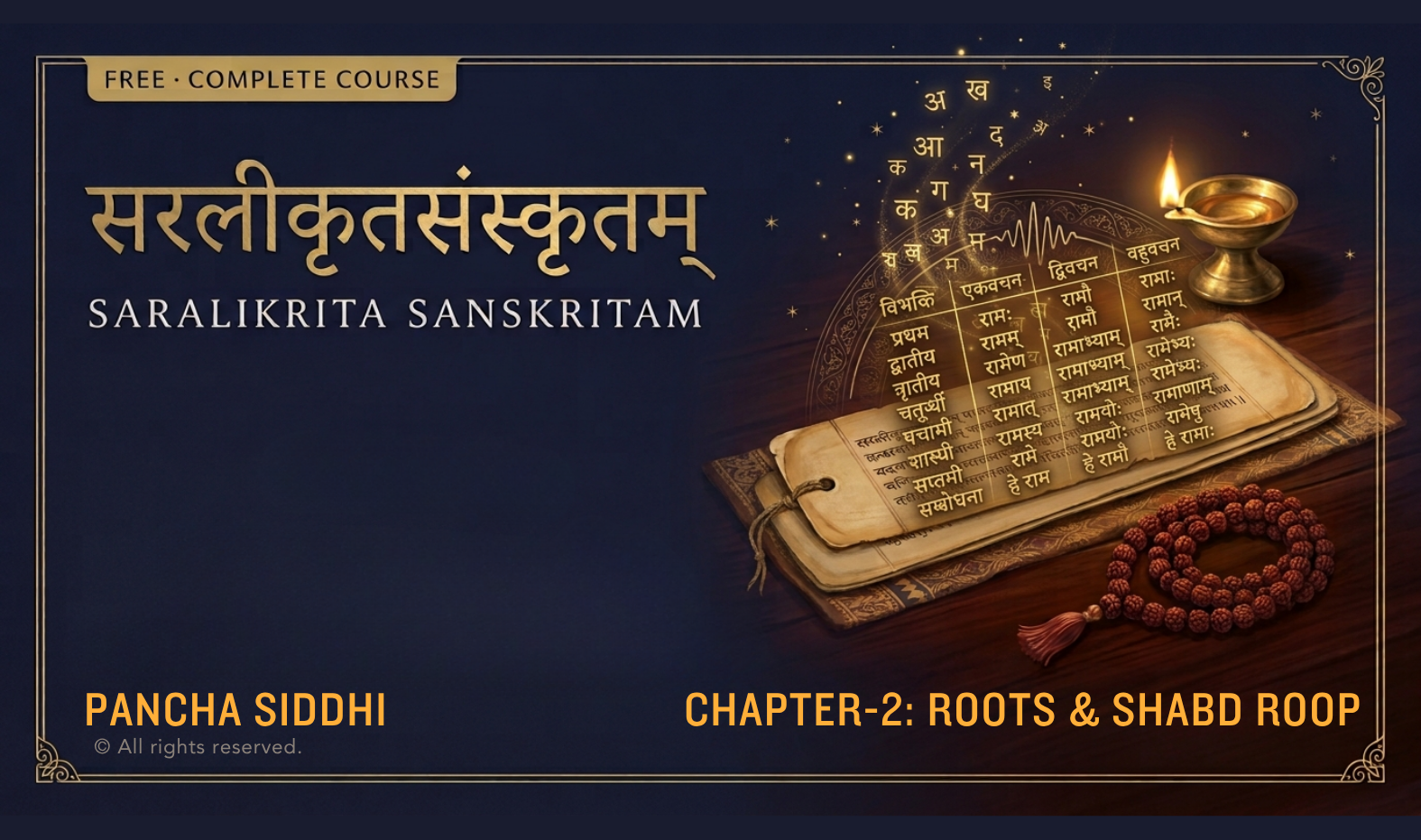
| विभक्तिः | एकवचनम् | द्विवचनम् | बहुवचनम् |
|---|---|---|---|
| प्रथमा (कर्ता – ने) | रामः (एक राम ने) | रामौ (दो राम ने) | रामाः (सब राम ने) |
| द्वितीया (कर्म – को) | रामम् (राम को) | रामौ (दो राम को) | रामान् (सब राम को) |
तृतीया (करण – से/के द्वारा) | रामेण (राम से) | रामाभ्याम् (दो राम से) | रामैः (सब राम से) |
चतुर्थी (संपदान – के लिए) | रामाय (राम के लिए) | रामाभ्याम् (दो राम के लिए) | रामेभ्यः (सब राम के लिए) |
पञ्चमी (अपादान – से अलग होने पर) | रामात् (राम से) | रामाभ्याम् (दो राम से) | रामेभ्यः (सब राम से) |
षष्ठी (संबंध – का, के, की) | रामस्य (राम का/के/की) | रामयोः (दो राम का/के/की) | रामाणाम् (सब राम का/के/की) |
सप्तमी (अधिकरण – में, पर) | रामे (राम में/पर) | रामयोः (दो राम में/पर) | रामेषु (सब राम में/पर) |
| सम्बोधन (पुकारना – हे!) | हे राम | हे रामौ | हे रामाः |
Every masculine अ-ending noun or word follows this exact pattern. गज (elephant), हस्त (hand), कन्दुक (ball), जनक (father), देव, बाल (boy) – all twenty-four forms become predictable once you hold this one table.