
The Chandra, or the Moon in Vedic astrology is the karaka of the mind, or Manas. Additionally, Moon is the second luminous planet in your kundli.
The Sun rules the atma, your soul; the Moon rules the mind that experiences your life. Therefore, the Moon governs how you feel, perceive, and remember every day. In fact, it is also not wrong to say that your Moon governs how your whole life will be. Ultimately, its the power of your mind.
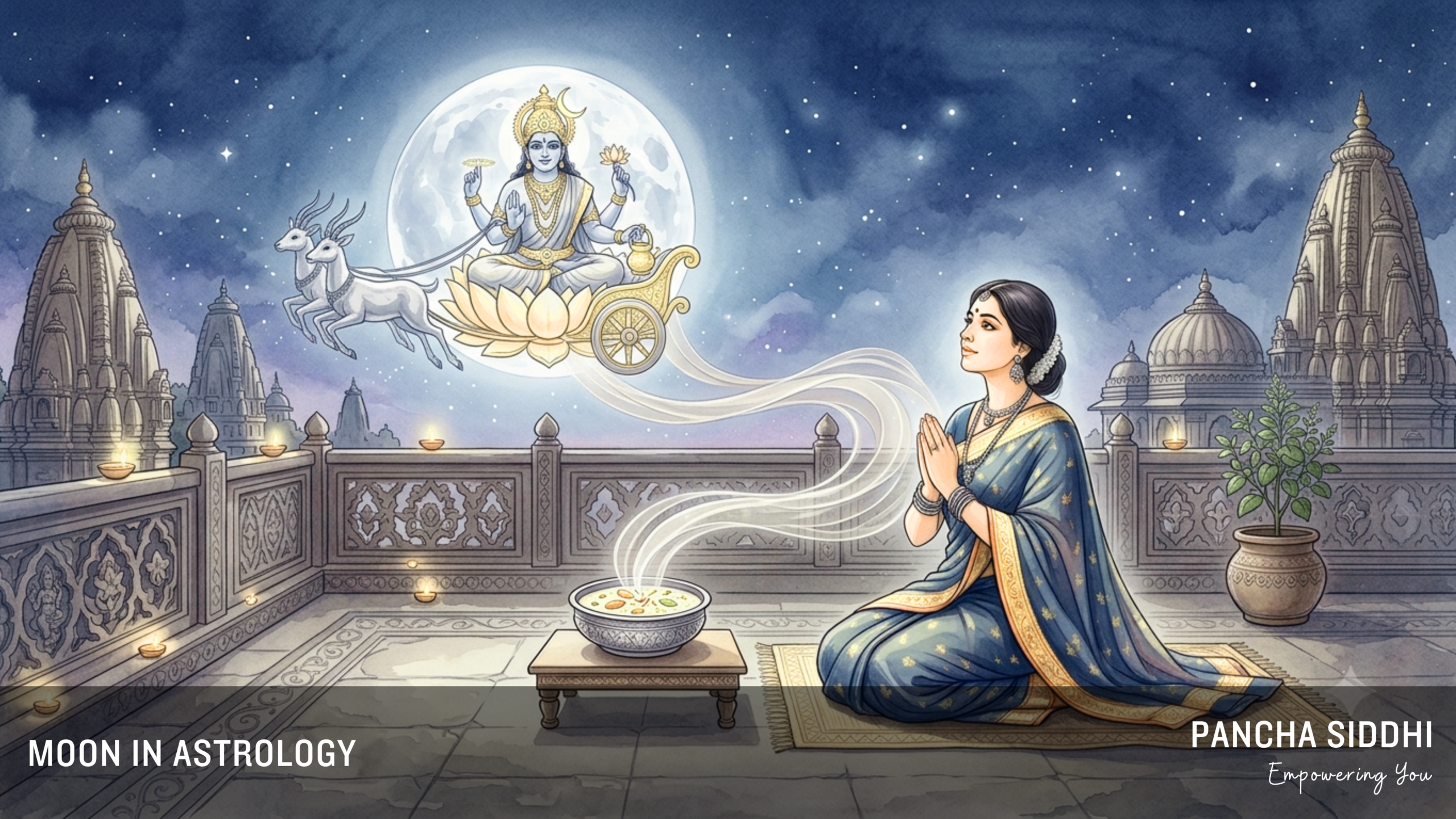
Vedic astrology reads the chart from the Moon as often as from the Lagna. The Moon is the emotional foundation of the horoscope. Whether you seek the soul’s peace or freedom from anxiety, the Moon holds your answer. Indeed, this single graha bridges spiritual longing and mental wellness alike.
In this Article
Importance of Moon in Vedic astrology for mind & emotions
The rishis considered the Moon the second luminous planet and the natural significator of the mind. Consequently, it also signifies the mother, emotions, memory, and mental peace.
Moreover, the Moon matters more than the Sun for daily lived experience. Why? Because it governs how you perceive your life, not merely who you are.
Manas means the sensing, feeling mind – the inner surface where every experience lands. Therefore, a restless or an afflicted Moon makes even a good life feel heavy and uncertain. This Mind-Moon link is not modern invention. Moreover, it is rooted in the oldest Vedic text.
चन्द्रमा मनसो जातः
From the mind of the cosmic Purusha, the Moon was born.
Properties of Moon in Astrology
The classical values below follow the Brihat Parashara Hora Shastra. Study them as the Moon’s complete signature.
| Particulars 🔹 | Moon's Significance 🌕 |
|---|---|
|
Sanskrit Names |
Chandra (चन्द्र), Soma (सोम), Indu (इन्दु), Shashi (शशि), Himanshu (हिमांशु) |
|
Nature |
Natural Benefic (except for an afflicted placement) & Waning condition |
|
Element (Tattva) |
Water (Jal) |
|
Ayurvedic Dosha |
Kapha (Waxing Moon), Vata (Waning Moon) |
|
Varna |
Vaishya |
|
Direction |
North-West |
|
Day |
Somawar (Monday) |
|
Metal |
Silver |
|
Colour |
White |
|
Raag |
Raag Yaman |
|
Exaltation Sign |
Taurus (वृषभ), peak at 3° |
|
Debilitation Sign |
Scorpio (वृश्चिक), peak at 3° |
|
Ruling Sign |
Cancer (कर्क), 4th sign in the Zodiac |
|
Mooltrikona (Auspicious Range) |
Taurus (वृषभ) 4°–30° |
|
Ruling Nakshatras |
Rohini (रोहिणी), Hasta (हस्त), Shravana (श्रवण) |
|
Friendly Planets |
Sun, Mars, Jupiter, Mercury: Neutral |
|
Enemy Planets |
Saturn, Venus, Rahu, Ketu |
|
Mahadasha |
10 years (Vimshottari Dasha System) |
|
Gemstone |
Ruby (माणिक्य), in Gold, Ring-finger |
|
Body Part/ System |
Mind (Brain), Lymph, Stomach, Left Eye |
|
Hormone/ Functional Gland |
Emotions (Pineal & Pituitary Gland), body fluids, sleep (Melatonin regulation contributing to Circadian rhythm along with the Sun) |
|
Relatives |
Mother |
|
Food |
Milk, rice, curd |
|
Career |
Nursing, psychology, hospitality, dairy, Navy/Merchant-Navy, public relations |
|
Business |
Dairy, beverages, pearls & silver, FMCG/public goods, hospitality Medical Equipment, Pharmacy |
The Moon as science & a Life-Management Tool
The Moon reflects the Sun’s light. Likewise, the mind is a reflective surface, never a source. Modern science confirms the Moon’s reach. Lunar gravity drives the ocean tides across the earth. Additionally, the human body is nearly sixty percent water.
Research links lunar and circadian rhythms to melatonin, sleep quality, and mood. Therefore, the ancient claim that the Moon rules the mind meets measurable biology. Jyotish is not superstition; it is a life-management system. The Moon’s placement shows where and how you must steady your mind.
Furthermore, it is good to consider that even if every aspect of your life is in turmoil and you have a subtle, calm mind, you can come across any challenge. In Jyotish, Moon’s placement represent this aspect. The better the placement of the Sun and the Moon in your chart, greater your life will be.
Read More: How the Moon affects the human mind? – An article by Pancha Siddhi